Storm & Emergency Response Tree Services - San Luis Obispo County (2025 Guide)
Storm & Emergency Response Tree Services in San Luis Obispo County
Storm & Emergency Response Tree Services
By Morgan Scovell, ISA Certified Arborist (WE-12338A) 4th Generation Tree
When big winter storms hit San Luis Obispo County, everything changes fast. Trees that looked solid the day before can snap, uproot, or start leaning toward a home with no warning. Rains saturate the soil, winds rip through neighborhoods, and by morning people are waking up to downed oaks, broken pines, blocked driveways, smashed fences, or branches sitting on their roof.
Each part of the county gets hit differently - the coast gets waterlogged, North County gets the wind, the foothills get both. And when a storm comes through, the calls come in all at once. That’s why having a local, certified, fully equipped tree crew matters.
At 4th Generation Tree, this is the kind of work we’re built for. We grew up here. We know these trees. And we’ve handled emergency removals all over SLO County for years — Paso Robles, Atascadero, Templeton, San Luis Obispo, Morro Bay, Cambria, you name it. When storms hit, we roll fast.
This guide lays out what actually happens during storm response, what homeowners should do right away, how insurance works, and why using a certified arborist matters after a tree fails.
Why Storm Damage Happens So Often Here
San Luis Obispo County has a strange mix of climates - inland heat, coastal moisture, heavy winter storms, and sudden wind bursts. Because of that, different areas fail for different reasons:
Cambria, Los Osos, Morro Bay, Cayucos: saturated soil + pine and cypress roots = uprooted trees.
Paso Robles, Templeton, Atascadero: sudden wind gusts crack heavy limbs or push over stressed oaks.
Santa Margarita, Creston, Pozo: shallow soils + water saturation = whole-tree failures.
A few main things cause most storm damage:
• Saturated soil
Trees lose all footing when the ground turns soft. Even big oaks can roll right out of the ground.
• Sudden wind shifts
It doesn’t take hurricane winds to snap a limb. One sharp gust at the right angle is enough.
• Neglected or overloaded canopies
A lot of trees around older homes haven’t been trimmed in 10–20 years, and they fail first.
• Weak species
Eucalyptus, acacia, and certain pines just don’t handle storms well.
When the weather hits, the county goes from calm to chaotic in an hour. That’s when emergency crews get called nonstop.
What to Do When a Tree Falls
Most people panic when a tree comes down, but the first steps are simple and extremely important:
- Don’t walk up to the tree
Uprooted trees shift. Limbs roll. Root plates move. What looks stable often isn’t.
- Check for power lines
If anything is touching or near a line, don’t try to help. Call PG&E or 911 immediately.
- Take photos before anything is moved
Insurance companies always ask for this. Thirty seconds of photos can save thousands.
- Call a real tree company — not a cleanup crew
Storm work is different. It’s technical and dangerous. Tension-loaded wood can whip or explode. You want certified crews who understand storm physics.
- Protect the structure
If there’s a roof puncture, tarp it once the area is safe. The longer you wait, the more interior damage you’ll deal with later.
We try to respond quickly because every hour you wait, things settle, shift, or get worse.
What Professional Storm Response Actually Looks Like
Storm work is its own category. It’s not “just another removal.” It requires the right equipment and the right judgment. Here’s how we handle it:
- Safety & structural assessment
We look at:
- pressure points
- where the tree wants to fall next
- whether the root plate is still moving
- which limbs are carrying weight
- what parts of the structure are at risk
This tells us how to piece it apart safely.
- Securing the site
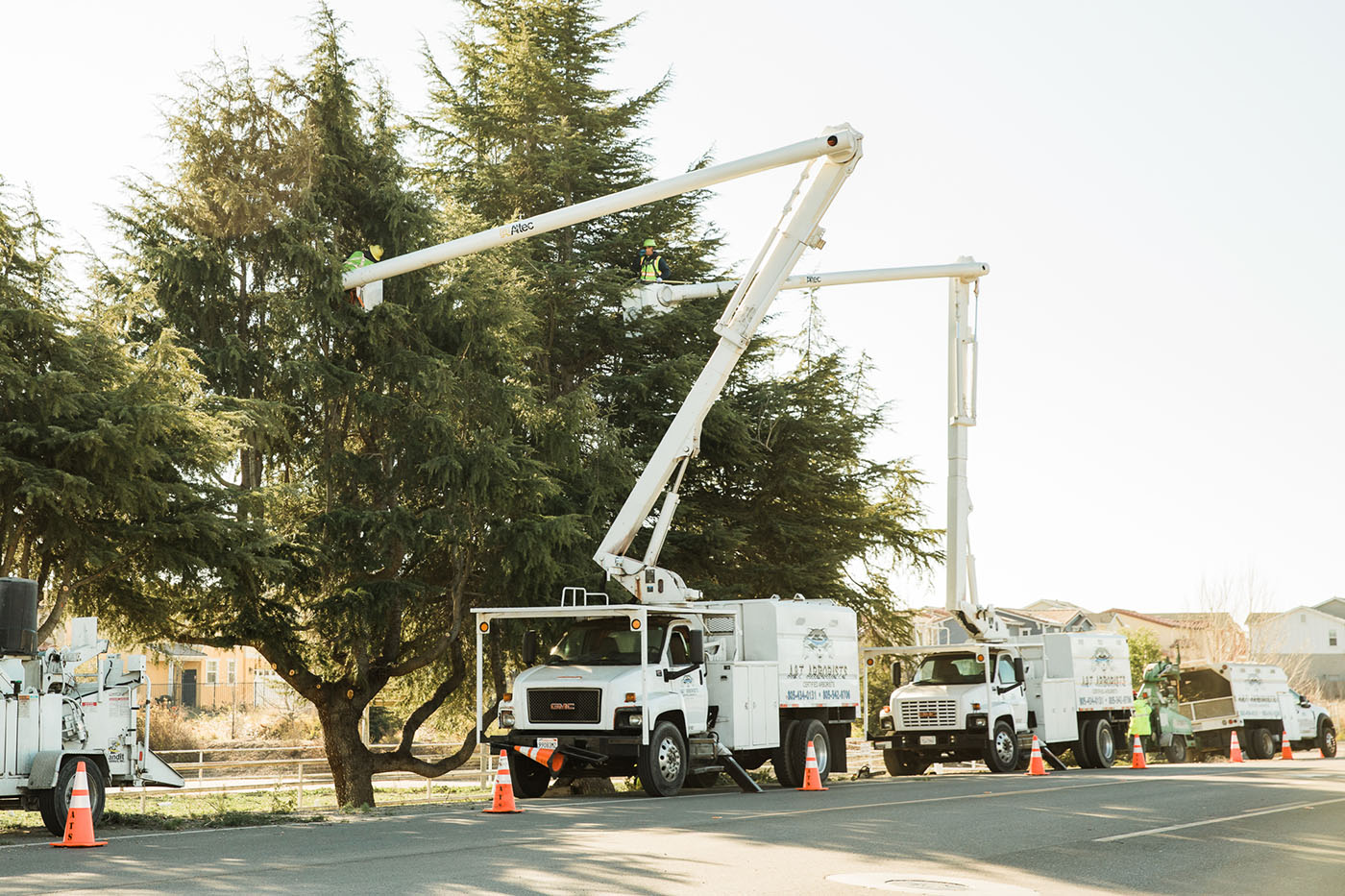
We clear the zone, set cones, block off the area, and make sure nothing is going to move unexpectedly while we rig.
- Controlled removal
Depending on the severity, we may use:
- Cranes
- bucket trucks
- heavy rigging
- ground saw crews
- skid steers or loaders
Every cut is directional. One wrong cut can make a trunk roll the wrong direction or send a limb through a roof.
- Protecting the home
We shield the area, use padding, plywood, and rig lines to prevent secondary damage.
- Cleanup
We can remove everything, leave wood, leave chips — whatever the homeowner prefers.
- Insurance documentation
We provide photos, descriptions, and itemized invoices. This makes insurance way easier for the homeowner.
Why a Certified Arborist Matters After a Storm
After a storm, people always ask the same things:
- Can the tree be saved?
- Is this dangerous now?
- Is there internal decay?
- Does the city require a permit?
- Will insurance cover this?
A certified arborist can answer all of it. That’s why we get called often for post-storm inspections.
We can evaluate:
- structural cracks
- decay pockets
- root plate failures
- future risk
- whether a tree is now considered “hazardous”
- whether a tree is salvageable or needs removal
Oaks, pines, redwoods, eucalyptus, sycamores — we know how each species behaves after a storm. That experience matters.
How Insurance Usually Works
A lot of people don’t know what insurance actually covers. In San Luis Obispo County, policies typically pay when:
- a tree hits a structure
- a tree blocks access to the home
- a tree creates a life-safety hazard
- emergency removal is needed for protection
Insurance usually pays for:
- removal off the structure
- the emergency hazard portion
- temporary protection (tarping, etc.)
Insurance usually does NOT pay for:
- full cleanup
- hauling logs
- stump grinding
- landscaping repair
We document everything so homeowners can get the maximum reimbursement.
How to Prevent Damage Before the Next Storm
Most storm failures could have been prevented with basic maintenance. We recommend:
- Thinning heavy crowns
- Removing dead or weak limbs
- Reducing weight on long horizontal branches
- Correcting old bad pruning
- Cabling cracked or split unions
- Removing severely compromised trees
- Annual checkups for trees close to structures
If a tree hasn’t been pruned in 5–8 years, storm risk goes way up.